April 2026 All-School Discussion Advances SMPH Strategic Planning
More than 150 faculty, staff, and learners gathered in person at the Health Sciences Learning Center and online on April 6, 2026, for the second All-School Discussion Session supporting the School of Medicine and Public Health’s strategic planning process. The session focused on sharing progress, showing emerging priority areas and enablers, and outlining next steps as the school moves toward finalizing its strategic plan in July 2026.
The discussion marked a key milestone as the process moves from earlier phases of listening and assessment to work focused on visioning, prioritization, and implementation.
Dean Nita Ahuja, MD, MBA, and Associate Dean for Faculty Affairs and Development Art Walaszek, MD, presented alongside experts from Deloitte Consulting, who facilitated discussion and addressed questions from the audience.
Broad Engagement Provides Key Insights to Strengthen the Plan
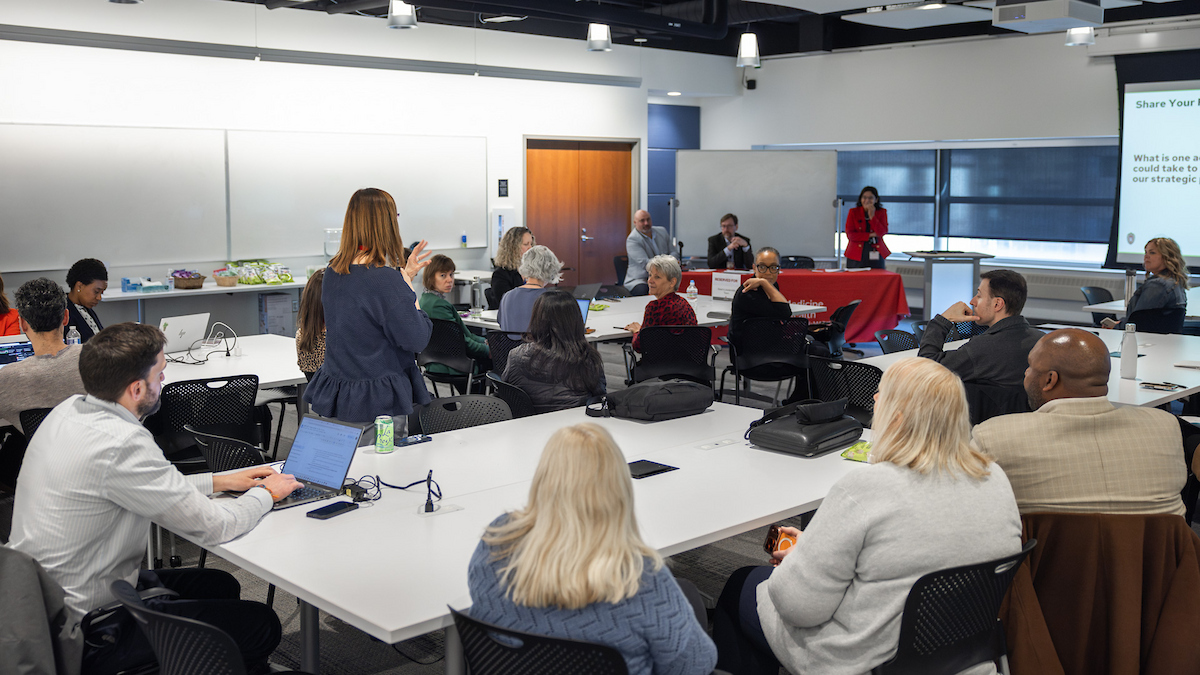
Presenters emphasized that the strategic planning work has been grounded in robust engagement across the school and beyond. More than 350 stakeholders have contributed through interviews, focus groups, benchmarking and visioning sessions. A wide range of roles have contributed perspective, including school faculty, staff and learners; colleagues from UW Health and throughout the university; and external partners.
Ahuja emphasized that the strategic plan is about making deliberate choices, rather than documenting current work or stopping essential efforts. “This is about investments in where we are going — that can scale us from where we are today to our next stage,” she said.
Discussing Priority Areas and Enablers
Walaszek shared information about the “Priority Areas” and “Priority Enablers” that are part of the current draft framework, which is intended to shape the plan. Priority Areas are areas of focus for collaboration, coordination and community alignment scoped broadly enough to represent work occurring throughout the school. Priority Enablers are critical supports that underlie each priority area.
Priority Areas
- Innovation and discovery through research
- Academic excellence and learner experience
- Patient care innovation and teaming
- Community engagement and social impact
- Importantly, public health is integrated as a throughline across all priority areas
Priority Enablers
- Partnerships and collaborations
- Attracting and developing exceptional faculty, staff and learners
- Administrative and operational excellence
- Financial sustainability and capital for investment
“Our mission, vision, and values remain at the core,” Walaszek said. “What this plan helps us do is align our work so we can better live up to our vision of healthy people and healthy communities across Wisconsin and beyond.”
From Priorities to Action
The goals, objectives and initiatives that are informed by the Priority Areas and Priority Enablers will be shaped by design criteria that maximize their potential. During design sessions, groups of individuals have been asked to evaluate and reshape as needed draft goals, objectives and initiatives based on these criteria:
- Growth accelerator: Does the goal have potential to drive significant growth within the school?
- Global reach and local impact: Does the goal uphold the school’s commitments to the state while achieving global relevance?
- Bold approach: Does the goal transform potential into action through ambitious and innovative initiatives? Is it aspirational?
- Better together: Does the goal combine collective strengths across the school and its partners, allowing collaboration to drive high achievement?
Next Steps in the Strategic Planning Process
Before starting the 30-minute question-and-answer session, the presentation concluded with a discussion of how the strategic plan will help the school realize its potential. For example, if successful, the strategic plan will position the school as a premier destination for innovation, talent, and impact, as well as leverage the school’s integrated status as a school of medicine and public health.
Strategic design and working group sessions will continue through June. A draft strategic plan will be shared for feedback at a final All-School Discussion on July 9.
“This plan will set our trajectory for impact,” Ahuja said. “Why did we all choose to work in or around health care? If we look in our hearts, we came to make an impact.”
This recap story was produced with assistance from Microsoft Copilot. Accuracy was reviewed by communications staff who attended the meeting in person.